HOHANK INTERNATIONAL GEN LATAM

Old generator update and expansion plan

Old generator update and expansion plan

In view of the high fuel consumption, frequent failures, insufficient capacity and difficulty in spare parts of old diesel generators, review the status, operating hours, maintenance records, parallel expansion, distribution transformation and replacement plans of the old diesel generators.

Old generator update and expansion plan

Old generators consume high fuel consumption and have many faults. How to judge whether to update or expand the capacity?

Just because the existing generator is still running does not mean that continuing to use it is the most economical option. Mining areas need to comprehensively evaluate operating hours, fault records, fuel consumption, load changes, spare parts availability and power distribution status, and clarify plans for new machines, parallel machine expansion, maintenance and renovation, or power distribution transformation.

Scene background

The problem with old machines is usually not a single failure, but a deterioration in reliability and cost.

Many mining areas already have generators, but their operation hours are long, fuel consumption is high, alarms are frequent, spare parts are hard to find, and on-site production needs to continue to be expanded or loads added. Just because the machine can still make noise does not mean that it can still reliably support production.

If you only buy a new machine based on its original power, you may ignore load changes, aging of power distribution, and increased startup shock. Renewal of old machines requires a simultaneous review of the unit, power distribution, maintenance and capacity range.
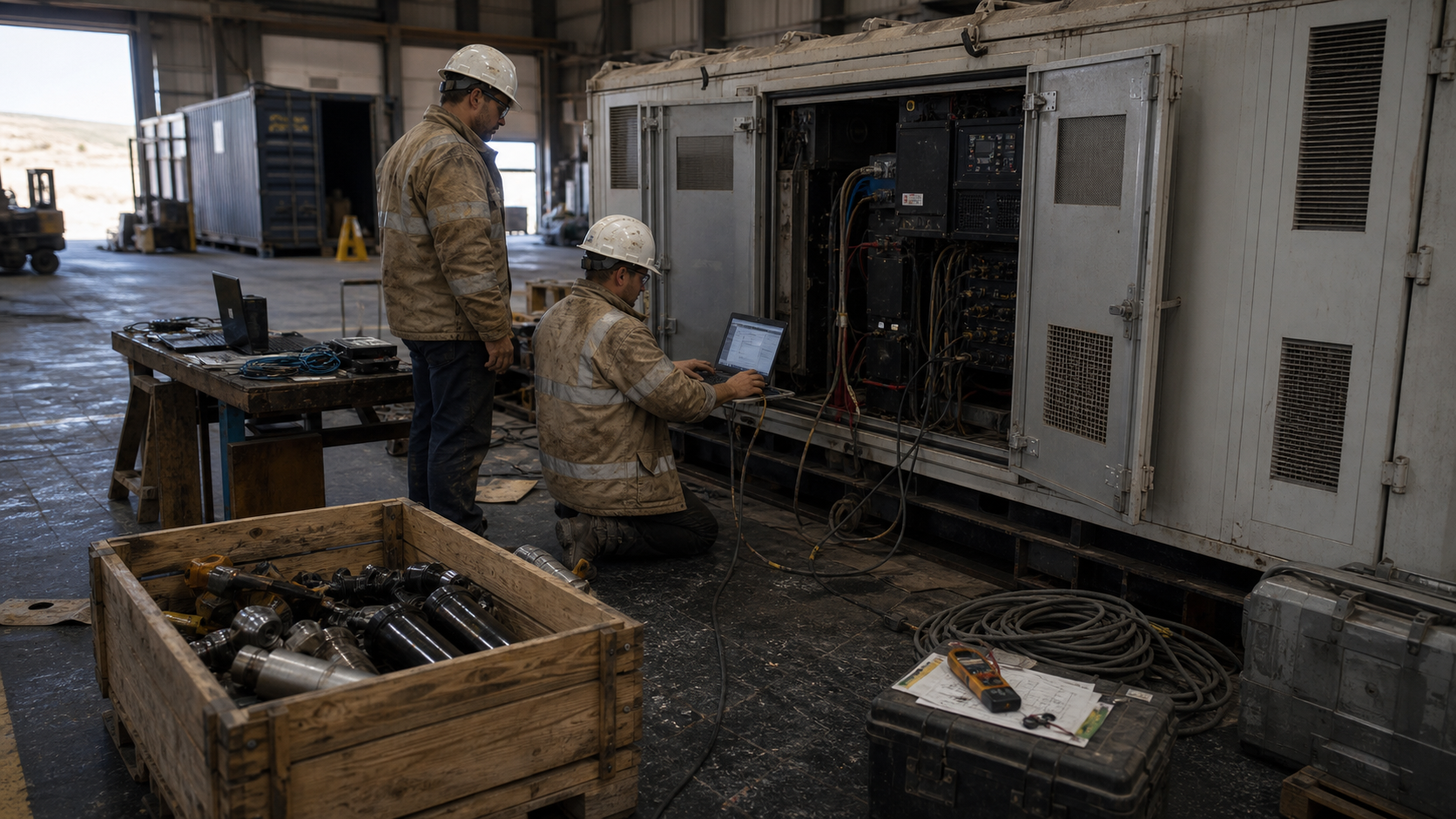

Onsite issues

Alarmed when the load was high. After repairing, it broke again. Firefighters were on site all the time.

The most common problem encountered by the person in charge of mine operations is that the old machine can barely run at ordinary times, but alarms when the crusher, water pump or workshop equipment are started at the same time. Maintenance personnel continued to replace small parts, but the problems of fuel consumption, shutdowns and starting failures were not really solved.

Spare parts availability can also slow down recovery. It is difficult to find old model controllers, AVRs, sensors or special parts. The only options on site are to temporarily reduce the load, rent machines, or demolish one wall to make up for the other.

Old generator update and expansion plan on-site problem scenario

The impact of not processing

Continuing to support the old machine will add up to fuel, downtime and maintenance costs.

The inefficient operation of old machines will increase diesel costs, frequent failures will interrupt production, and temporary maintenance and temporary rental will also increase management costs. It seems that the purchase cost is saved, but in fact the cost may be spread into daily operations.

If the mining area is expanding, the problem of old machines will also hinder the new equipment. Insufficient capacity, aging power distribution and confusing protection logic will make it more difficult to stabilize the power system after expansion.

Recommended configuration

After the physical examination of the old machine, the plan for replacement, parallel machine expansion or power distribution transformation will be determined.

When updating an old machine, a status inventory must be done first: operating hours, maintenance records, fault records, fuel consumption, load rate, alarm codes, existing power distribution diagrams and future load changes must be put into the same table.

The solution is not necessarily just replacement. Old machines can be returned to standby, new machines can be paralleled for capacity expansion, low-voltage power distribution and protection logic may need to be redone; if operation continues in the short term, spare parts packages and maintenance plans must also be supplemented first.

Configuration confirmation steps

Confirm legacy machine status, load growth and service availability

The first step is to check the running hours, fuel consumption, temperature, alarms, oil leakage, starting performance, maintenance history and key component status of the old machine to distinguish whether it is due to engine aging, maintenance gaps, undersized selection, or external power distribution.

The second step is to review the on-site load changes. After new crushing, pumping stations, air compressors, workshop equipment or camp loads are added, the units and low-voltage cabinets that were sufficient in the past may no longer be suitable for the current startup shock and continuous load.

The third step is to evaluate spare parts and service availability. If core controllers, AVRs, sensors and special parts are difficult to find, the update plan must take into account the risk of downtime, rather than just comparing the purchase price of new machines.

Onsite income

Updating old machines becomes a calculable trade-off, rather than replacing them if they break.

After the evaluation is completed, the choice of whether to stay or leave the old machine will become clear: continue to be used as the main machine, retire to standby, parallel with the new machine, or withdraw from the site. It can also be seen that power distribution and maintenance issues must be addressed simultaneously.

This can avoid mechanical replacement at the original power. Old and new units, future expansion, fuel consumption, spare parts, commissioning responsibilities and service response are compared together, so the site does not have to passively switch between repeated repairs, temporary rentals and sudden production shutdowns.

Check before quotation

Common signals on site

  • The old machine runs for a long time and its fuel consumption increases significantly.
  • Frequent alarms when the load is high, large motors are started, or multiple loads are running at the same time.
  • Filters, controllers, AVRs, sensors or specialized spare parts are becoming increasingly difficult to find
  • The production site has been expanded, but the unit and power distribution are still configured according to the past load
  • Short-term recovery occurred after maintenance, but similar faults recurred after a period of time.

If you don’t plan ahead

  • Continue to hold on to old opportunities and add fuel, downtime, maintenance and temporary rental costs
  • Only replace the new machine with the original power, which may ignore the load increase and startup impact.
  • Old machines, power distribution and protection logic problems are mixed together, and faults occur repeatedly
  • Core spare parts are becoming increasingly difficult to find, and recovery time and service costs are uncontrollable.
  • After the expansion equipment is connected, the old system may continue to hold back new production capacity.

Project confirmation points

  • Old machine operating hours, maintenance records, fault records and fuel consumption data
  • Current load list, startup methods, simultaneous running loads and future expansion plans
  • Existing low-voltage distribution cabinets, circuit breakers, cables and protection logic status
  • Critical spare parts availability, repair response time and on-site maintenance capabilities
  • Cost range for updating, maintaining spare capacity, parallel expansion, or redoing power distribution

Recommended configuration range

  • Old machine status assessment and load review
  • New machine replacement or new and old machine parallel expansion plan
  • Review of low voltage power distribution, protection logic and cable paths
  • Basic or enhanced spare parts package
  • Commissioning handover, maintenance cycle and remote diagnosis process

Engineer assistance

Contact the engineer first, and then determine the equipment and service scope together

Which solution is more suitable for the current load, whether the old machine should continue to be used as the main machine, be used as a standby, parallel to expand the capacity, or directly replaced with a new machine?

Device and module scope

Replacement of new machines, paralleling of old and new machines, review of low-voltage power distribution, status assessment of old machines, spare parts plan and debugging handover data.

Engineers will help you sort out the information

  • Old machine operating hours, maintenance and fault records
  • Current load list, startup method and expansion plan
  • Photos of existing distribution cabinets, cables and protection logic
  • Critical spare parts availability and repair response

Related equipment and services

Old machine status assessmentNew machine replacementParallel expansionPower distribution transformationSpare parts and maintenance schedule

Engineer contact

Contact the engineer first and let the engineer help you determine the configuration.

If the information is incomplete, you can contact us first. You only need to first explain the location of the mining area, on-site problems or general equipment conditions, and the engineer will work with you to sort out the load, site conditions and configuration range.

Scan the WhatsApp code to contact the engineer

Engineers will contact you soon to understand your questions and needs.

Scan the WhatsApp code to contact the engineer
or leave your contact information

Engineers will contact you soon to understand your questions and needs.

Contact engineer service