Module 01
Diesel generator set: first determine the main, backup and structural forms
Judge open frame, containerized or mobile units based on continuous load, starting shock, operating hours, altitude and site layout.
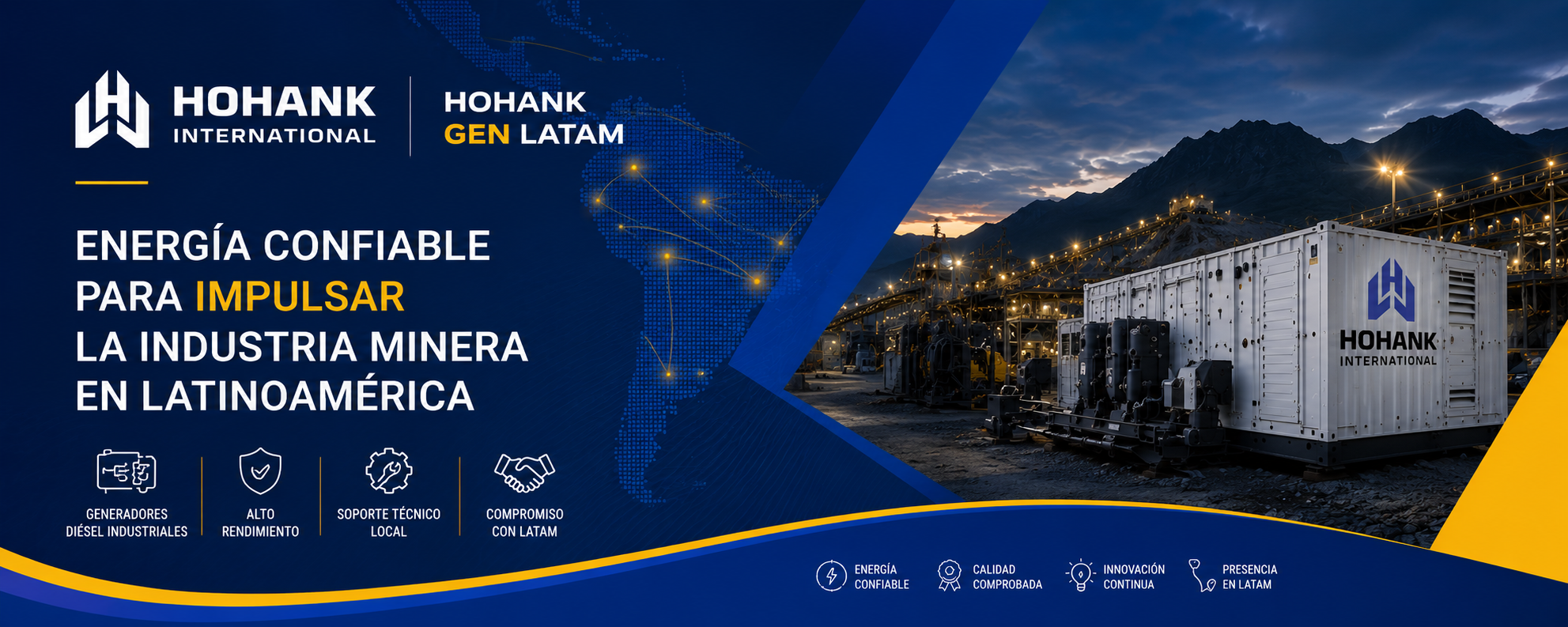
Direct mining equipment for Ecuadorian mining companies
We focus on serving Ecuadorian mining companies, reviewing the configuration of diesel generator sets, ATS, parallel machines, power distribution, fuel and spare parts support based on the location of the mining area, load list, voltage frequency, starting method, altitude, operating hours and after-sales needs.
Familiar with the Ecuadorian mining site and service conditions.
Review the entire power supply system configuration according to mining conditions.
Engineering team follow-up and spare parts warehouse support.
Matches reliable brands such as Weichai, Cummins, and Yuchai.
Power supply system composition
Judge open frame, containerized or mobile units based on continuous load, starting shock, operating hours, altitude and site layout.
Zone the crushing, drainage, camp, maintenance workshop and safe load zones, and then confirm the configuration of ATS, circuit breakers, cables and low-voltage cabinets.
It is used for parallel connection of multiple diesel generators, load distribution, synchronous control, automatic start and stop and capacity expansion reservation, and is suitable for mining areas that are put into production in stages.
For long-term self-generation in remote mining areas, daily fuel tanks, large fuel tanks, refueling routes, operating hours and fuel costs must be confirmed simultaneously.
Record operating hours, load, voltage frequency, alarms and maintenance reminders through the controller, communication interface or monitoring module to facilitate remote diagnosis.
Prepare filters, belts, controllers, AVRs, training, and service response by operating hours, remoteness, and critical loads.
I don’t know how to combine these modules? Let the engineer explain the configuration range according to the mine load and site conditions.
Contact engineer serviceMine power system design
First, clearly explain power outages, voltage fluctuations, inability to expand production, drainage and power supply, power supply for construction, fuel costs or old machine replacement, so as to avoid quoting only based on power at the beginning.
Determine on-site problems 02Crushing, screening, conveying, pumping stations, camps, maintenance workshops and safety loads should not only look at the total power, but also the starting method, simultaneous operation relationship and power outage priority.
Review payload list 03What is often needed at the mine site is not a single generator, but a combination of unit, ATS, parallel machine, low-voltage power distribution, fuel system, remote monitoring and spare parts.
View system configuration 04Before quoting, confirm the installation and commissioning, operational training, spare parts package, remote diagnosis, local collaboration, response timeliness, as well as which services are included in the quotation and which need to be billed separately.
Confirm after-sales standardsContact an engineer
If you are temporarily unclear about capacity, ATS, parallel operation, power distribution, fuel and after-sales scope, you can also leave your contact information first and we will communicate on a case-by-case basis based on the project situation.
Deliver after-sales support
Buying equipment is just the beginning. What the mining area really needs to confirm is who is responsible for installation inspection, debugging assistance, operational training, spare parts preparation, fault diagnosis and service response after the equipment arrives at the site.
After the equipment arrives at the site, it is necessary to confirm the foundation, grounding, cables, low-voltage power distribution, ATS, parallel conditions and first load commissioning arrangements.
Startup and shutdown, load switching, alarm viewing, inspection records and daily maintenance requirements must be handed over to the person in charge of the site.
Confirm spare parts packages such as filters, belts, sensors, controllers, AVRs, etc. in advance based on operating hours and remoteness.
When a fault occurs, operation records, alarm information and on-site photos must be used to determine the problem first, and then remote diagnosis, local collaboration and service response can be arranged.
After-sales service must be confirmed clearly before quotation and delivery to avoid failure in installation, spare parts, remote diagnosis, local collaboration and fault response after the equipment arrives.
Construct risk avoidance
Let’s first look at some of the problems that are most likely to lead to production shutdowns, tripping, out-of-control fuel consumption and after-sales waiting. The complete list can be viewed item by item in the pit avoidance guide.
Remote mining areas are not just afraid of major failures. Filters, belts, sensors, controllers, AVRs, pumps and electrical parts are not ready, and minor failures can cause downtime for several days.
Drainage pumps, tailings pumps, water treatment and safety monitoring cannot be powered off together with ordinary production loads. Before construction, it is necessary to confirm which safety loads must be independently powered.
Having a generator does not mean having a backup power supply. Which loads are protected by active, backup and ATS switching during a power outage need to be clarified in advance before configuration.
The generator capacity is large enough, but if the low-voltage cabinets, circuit breakers, cables and load partitions do not keep up, there will still be voltage drops and trips on site. When purchasing, the power distribution should be reviewed together.
It is easy to underestimate the startup impact of crushers, water pumps and air compressors by only looking at the equipment nameplate power. Before purchasing, review the starting current, simultaneous operation and expansion margin.
Expansion is not just about adding a new piece of equipment, power capacity, power distribution, cables, fuel and spare parts must keep up. Otherwise, the new equipment may not be able to be started after it arrives at the site.
Remote mining areas have long-term self-generated power, and the real big costs are often diesel, transportation, maintenance and downtime costs. When comparing prices, don’t just look at the purchase price of the generator.
Having a generator does not mean that there is stable power on site. Daily fuel tanks, large fuel tanks, replenishment frequency and transportation routes are not well planned, and the unit may shut down due to lack of oil.
Review of Ecuador mining case
The customer initially asked about the backup diesel generator. As engineers continued to learn about the mining site, they discovered that what really needed to be solved was the simultaneous impact on production lines, dewatering pumps, campsites, and communications during a power outage. By reorganizing key loads, startup sequence, ATS switching, low-voltage power distribution, fuel replenishment and after-sales response, we help customers avoid the losses caused by buying only one piece of equipment and still being unable to carry the load, water drainage interruption, camp power outage, repeated power replenishment and production shutdown.
At first, the customer only said that the power supply in the mining area was unstable and wanted to add a backup diesel generator. The engineer did not immediately quote the price based on the power meter, but first asked where power outages usually occur and which equipment would be forced to stop.
After the engineers continued to communicate, the on-site problems became clearer: breaking lines, drainage pumps, camp lighting, communications and maintenance workshops would all be affected by the power supply, among which drainage and safety loads could not wait until manual switching and then restored.
If you only configure the machine according to the lowest power, the generator seems to be cheaper, but the crusher and water pump may have a voltage drop and trip when they are started, and there will be no margin after expansion. Engineers rechecked the starting current, simultaneous operation relationship and key load priority.
After review, the engineer judged that the plan should not only stop at one diesel generator, but also confirm the diesel generator set, ATS, low-voltage power distribution, fuel system, monitoring interface and common spare parts together to let the customer know the true scope of purchase.
Before the equipment arrives at the site, engineers list the foundation, cables, grounding, hoisting, oil circuits, exhaust, start-up test, load test and operation training one by one. The on-site team knows what to prepare first and how to access and debug after arriving at the site.
After operation, if alarms, tripping or starting difficulties occur, engineers will first determine the scope of the problem based on controller photos, fault codes, operating hours and maintenance records, and then arrange remote diagnosis or local collaboration.
The engineer said: What we are most worried about is that customers only pay attention to the lowest power and the price of a single unit, and ignore access debugging, power distribution and after-sales response, which ultimately affects production, drainage and camp electricity use. Our goal is to provide stable, safe and cost-controllable power supply for mining production and life.
Engineer contact
Engineers will contact you soon to understand your questions and needs.