Project Background
A New Inpatient Building Beside the Existing Hospital Required Both Generator and System Scope
The expansion added an inpatient building beside an existing hospital, with surgery, ICU, pharmacy cold storage, laboratory and imaging areas, IT, clean HVAC, water and support equipment. Procurement first focused on generator rating, lead time and budget; facilities focused on real operation: first-attempt starting, stable voltage and frequency, nighttime test noise, and fuel and refueling pressure during a long outage.
The hospital needed one plan covering generator performance, installation, transfer order, acceptance records and maintenance. Equipment quality formed the base, load priorities and ATS/UPS formed the chain, and ongoing inspection protected long-term reliability.
Hospital backup must assess generator quality and system handoff together. A reliable, quiet and efficient set reduces maintenance pressure and improves site operation.
Challenges and Requirements
Clinical Continuity, Generator-Room Constraints and Operating Cost Converged in One Project
Operating rooms, ICU, pharmaceutical cold chain and IT were highly sensitive loads; elevators, water, security and selected clean HVAC also affected patient movement and site order. Starting time, output stability, noise, exhaust, fuel runtime and service windows therefore had to be reviewed together.
The existing set could serve part of the old load, but the new building required reassessment of capacity margin, controls, ATS zones, fuel and ventilation. The hospital wanted to avoid discovering noise complaints, poor exhaust routing, low-load carbon, unclear fuel management or clinical transfer order after equipment arrival.
Reliable starting, stable voltage and frequency, efficient fuel use, low noise, adequate cooling and clear service space.
Transfer operating rooms, ICU, cold chain, IT rooms and safety loads by priority.
Keep test-run, on-load, transfer, fuel-level, alarm and inspection records available over time.
Generator-Set Solution
Configure the Generator for Reliability, Fuel Efficiency, Low Noise and Serviceability
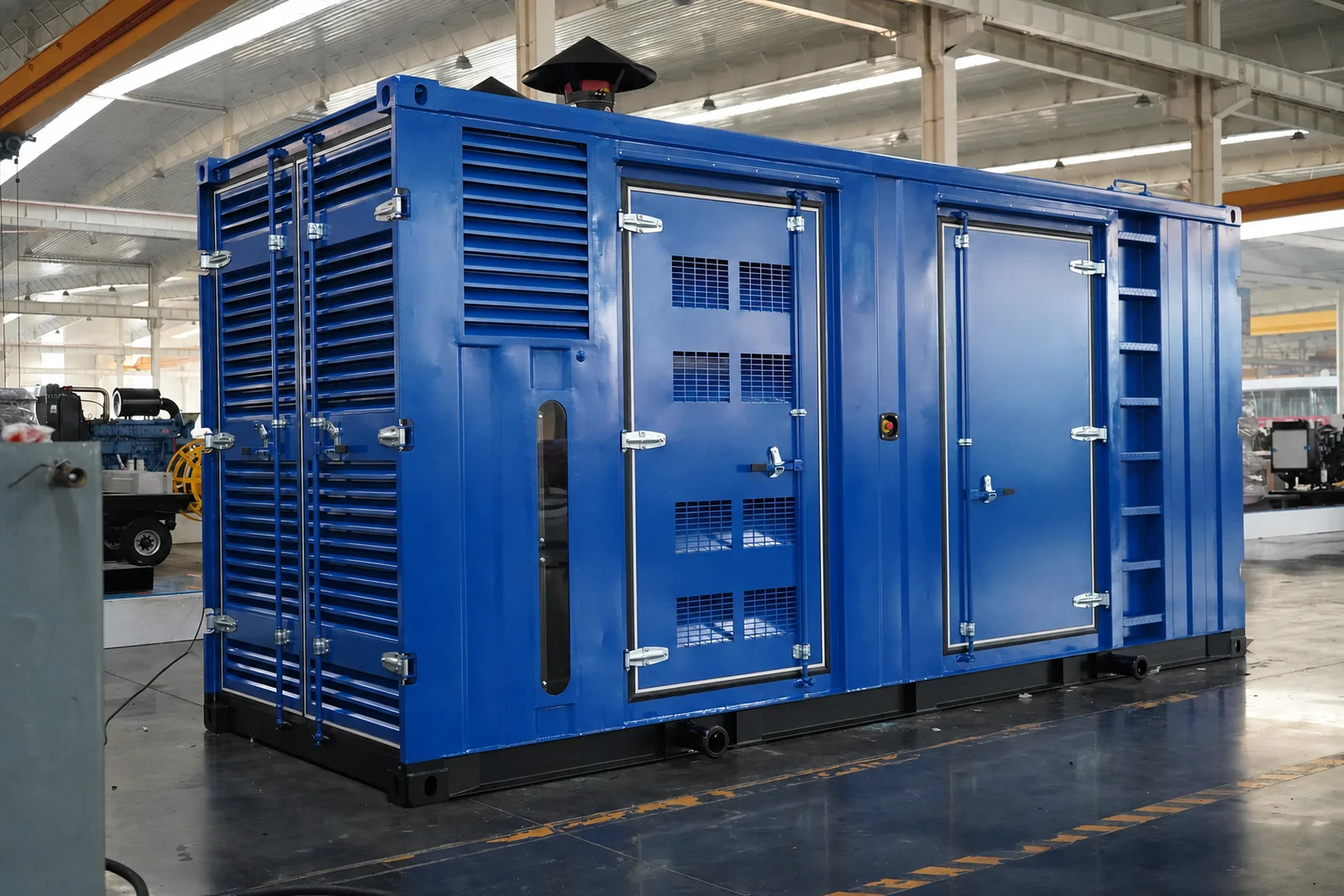
The generator is the core of hospital backup. The engine must start quickly and remain stable as critical loads connect; alternator and AVR behavior must protect UPS, monitoring, IT and cold-chain controls; and the controller must retain start, run, alarm and shutdown data for inspection.
Fuel efficiency depends on operating in a suitable load range. Day and night hospital loads differ, sustained low load increases maintenance, and oversizing increases purchase, fuel and service cost. Capacity, staged loading, expansion and test conditions were therefore assessed together.
Noise and reliability were built into the generator plan. Near inpatient, outpatient or residential boundaries, the set required attenuation, airflow silencers, vibration isolation, exhaust height and door clearance. Radiator, ducting, fuel, wiring, controls and consumable replacement paths all affect future serviceability.
- 01Judge quality by the complete set: engine, alternator, controller, cooling, fuel, enclosure and wiring.
- 02Assess fuel use against daytime peaks, nighttime low load, test frequency and future expansion.
- 03Match attenuation to the hospital environment through enclosure, silencers, isolation, exhaust and service access.
Power-System Solution
Load Priorities, ATS/UPS and Fuel Runtime Were Built Around Generator Capability
After selecting the generator, loads were split into three tiers. Operating rooms, ICU, nurse communications, core IT and critical emergency lighting transferred first. Pharmaceutical cold chain, diagnostics, IT cooling, selected water, elevators and access recovered next. Offices, comfort cooling and noncritical lighting were delayed.
ATS zones followed load priority, while UPS review verified the window from utility loss to stable generator output. Fuel planning covered tank capacity, low-level alarms, refueling access, fire safety and cost. Low-voltage review checked breakers, cables, grounding, feeder capacity and expansion interfaces so critical circuits could actually connect.
Operating rooms, ICU, life-support equipment, core networks and critical lighting.
Pharmaceutical cold chain, diagnostics and imaging, IT cooling, water, elevators and security.
Start, load, ATS transfer, UPS window, fuel-level, alarm and inspection data.
Professional Engineering Services
Engineering Connected Equipment and System from Site Review through Commissioning
Inputs included building functions, load lists, existing generator data, panel photographs, room location, exhaust route, fuel and noise boundaries. Outputs defined generator form, capacity margin, attenuation, ATS zones, UPS window and low-voltage changes.
After arrival, service covered vibration isolation, airflow, exhaust, fuel, grounding, controls, ATS interfaces and access. Commissioning recorded no-load start, loaded condition, transfer, voltage and frequency, oil pressure, coolant temperature, alarms and corrective items in a form procurement, facilities, clinical and maintenance teams could understand.
- 01Before arrival: confirm dimensions, lifting route, foundation, exhaust, noise boundary and service space.
- 02During installation: confirm fuel, cables, grounding, control wiring, ATS interface, ventilation and fire-safety boundaries.
- 03At handover: confirm start, loading, transfer, UPS window, alarm records and operator handoff.
After-Sales and Operations Support
Continue Tracking Fuel, Alarms, Testing and Spares After Handover
After handover, reliability depends on maintenance rhythm. A fixed form captures hours, starts, load factor, fuel use and level, coolant, battery voltage, alarms, ATS state and tests. Remote monitoring provides early data; without it, periodic photographs and records maintain visibility.
Spares were planned by generator model: filters, belts, starting batteries, sensors, chargers, controller parts, common electrical items and consumables. From day one, the set had operating records, service milestones and a fault-response path.
Results and Feedback
The Hospital Saw a More Stable Generator, Quieter Operation and Clearer Handover
The project moved from equipment purchase to a verifiable, operable and maintainable delivery. Facilities could explain the generator choice, transfer priorities, fuel and testing, noise and exhaust controls, and maintenance ownership.
Results were tangible: equipment quality had evidence, attenuation and installation boundaries were clearer, clinical transfer order was defined, tests were traceable and service no longer depended on ad hoc communication. This delivered more value than equipment alone.
A well-delivered hospital generator facility brings the set, transfer system, operating records and support into daily management.