Construction, emergency repair and event work changes location repeatedly
The unit moves between worksites, plants or service points and can begin work after stabilization, grounding and connection.
Product Range / Towable Multi-Site Power
A diesel generator set, low-noise weatherproof enclosure and trailer chassis combined as a redeployable temporary power source. It suits construction, emergency repair, events and maintenance outages, provided the load, tow vehicle, route, brakes, stabilizers, connections and required runtime are considered together.
Why Choose a Trailer-Mounted Set
The value is the ability to dispatch, stabilize and connect the set quickly—not simply the addition of wheels. The product must satisfy electrical, road-movement and on-site operating requirements at the same time.
The unit moves between worksites, plants or service points and can begin work after stabilization, grounding and connection.
Suitable for pumps, welders, lighting, temporary offices and maintenance loads without purchasing a fixed generator for every site.
Axles, brakes, hitch height, road lighting and markings must match the vehicle and local rules. Rating alone is not enough to specify a trailer.
Hospitals, data centers and other fixed critical loads still require a complete ATS, fuel, distribution, redundancy and scheduled-testing system.
Trailer Configuration Range
Chassis type follows total weight, road condition, turning space, dispatch frequency and stability during operation. Larger sets need stronger axles, brakes and stabilizers.
For smaller ratings, short movements within a site or occasional relocation, emphasizing compact steering and quick deployment.
Can use a movable drawbar and 180-degree turntable for easier positioning in plants, worksites and confined areas.
For higher ratings and greater operating weight, configured around axle loads, tires, braking and stabilization.
For frequent and longer-distance road moves, with vehicle connection, braking, lighting and compliance reviewed separately.
Available ratings cover approximately 15kW to 1000kW. Final rating, enclosure, chassis, axle count, braking and road configuration are confirmed against operating weight, travel distance, tow vehicle, local requirements and site conditions.
Ratings and Engine Platforms
Temporary power still requires starting and power-quality checks. The combination of pumps, welders, compressors and sensitive equipment determines both generator capacity and connection method.
Mobile Structure and Customer Value
Road safety matters in transit; stable placement and quick connection matter on site. If any one area is missing, mobility can become an additional risk rather than a benefit.
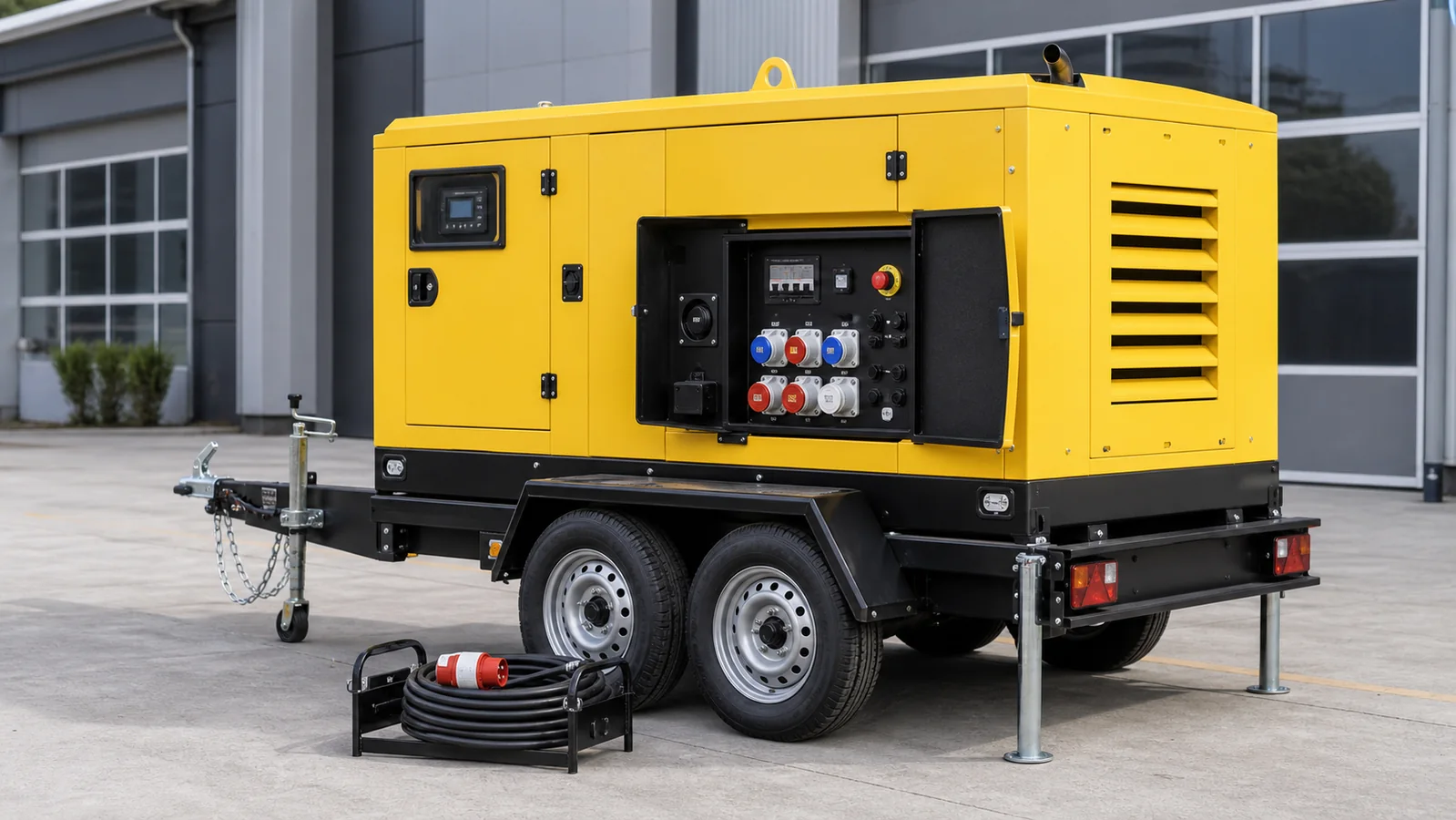
Hitch type, towing height and turntable design affect vehicle matching and maneuvering in confined areas.
Operating weight must be distributed across axles and tires with margin for road and ground capacity.
Service brakes, parking brakes, lighting and markings follow the travel distance and applicable local requirements.
Mechanical or hydraulic supports stabilize the chassis during operation so slope and vibration do not affect the equipment.
The enclosure balances outdoor protection, acoustics, airflow and safe separation from nearby personnel.
Front-to-rear airflow and two-sided service access support cooling, inspection and repeated maintenance across sites.
A base or larger-capacity tank is selected around task duration, refueling access and transport weight.
Quick-connect panel, cables, grounding, protection and emergency stop should be configured and checked before dispatch.
Six Deployment Inputs
List pumps, welders, compressors, lighting and sensitive equipment to define maximum simultaneous load and starting method.
Confirm 50Hz/60Hz, voltage and phases, plugs or terminals, main breaker, cable length and grounding method.
Check towing capacity, hitch height, axle load, braking, tires, route and applicable road requirements.
The parking area must be levelable, support the weight, allow clean airflow and exhaust, and maintain distance from people and combustibles.
Use continuous operating hours, refueling access, nighttime duty and nearby receptors to select the tank and enclosure.
Define responsibility for towing, connection, routine checks, operating records, spare parts and cross-site maintenance.
Choosing the Mobility Format
| Comparison | Trailer-Mounted Set | Truck-Mounted Power Station | Fixed Sound-Attenuated Set |
|---|---|---|---|
| Movement | Towed by a matched vehicle and dispatched between assignments. | Generator, distribution and operator space integrated on a dedicated vehicle. | Remains at the installed location and is not designed for frequent moves. |
| Primary value | Flexible acquisition and dispatch, allowing one power source to serve several temporary sites. | Faster deployment and emergency response, with more operating facilities carried on the vehicle. | Straightforward fixed outdoor acoustics, weather protection and routine service. |
| Confirm first | Tow vehicle, route, brakes, leveling, grounding and connections. | Vehicle compliance, onboard distribution, cable handling, personnel space and maintenance. | Acoustics, cooling, foundation, fuel and fixed system interfaces. |
| Typical tasks | Construction, emergency repair, maintenance transitions, events and rental fleets. | Public emergency response, specialist support and frequent fast-response assignments. | Hotels, hospitals, schools, shopping centers and fixed equipment areas. |
Typical Project Tasks
For pumps, welders, lighting, tools and temporary offices, confirm starting demand, site connection and safety separation.
Prepare cables, grounding and switching in advance, then connect by load priority to avoid extending an outage through on-site decisions.
Standardized interfaces, run-hour tracking, remote alarms and a spare-parts plan improve utilization and reduce operating errors.
Typical configurations · Not the complete range
The range is not limited to the models below. These examples show common outputs, brand combinations and package choices; refer to the series overview for full coverage and available options.
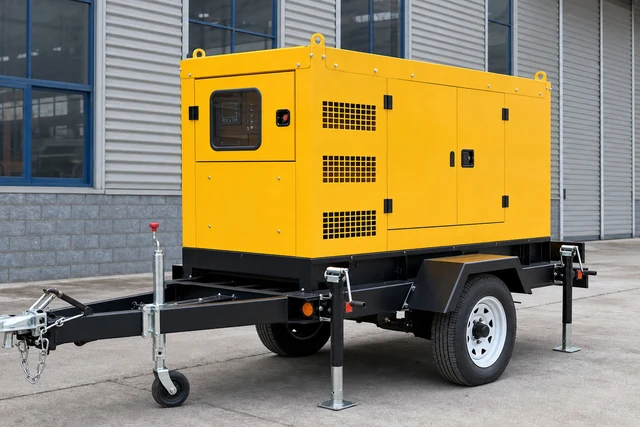
A compact 100 kW Yuchai trailer package focused on tight sites, rapid movement and connection.
View this configuration →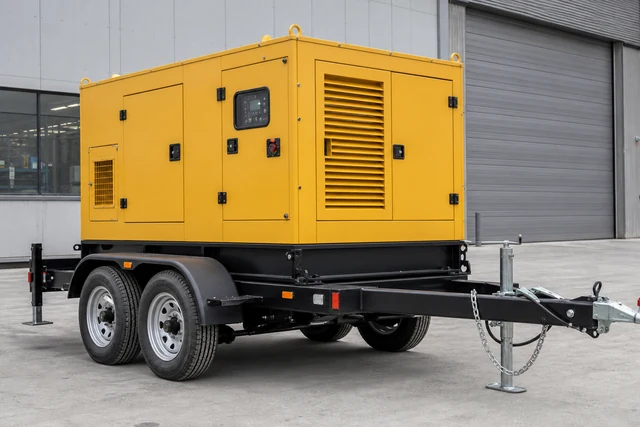
A 300 kW Cummins tandem-axle package balancing tow stability, acoustic protection and rapid output.
View this configuration →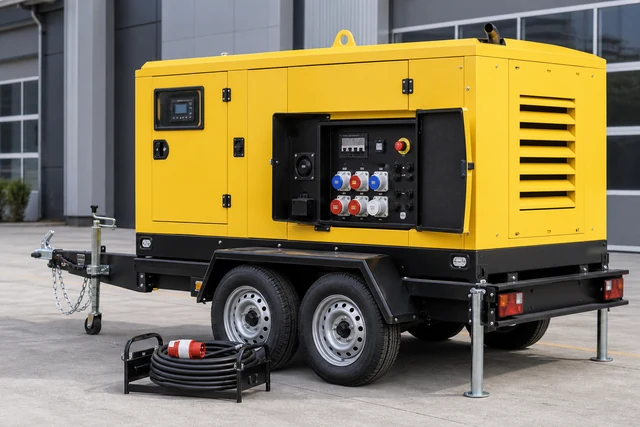
An 800 kW Weichai heavy-axle package coordinating generation, specialized transport and rapid deployment.
View this configuration →Share the country and city, critical loads, required rating, movement frequency, tow vehicle, route, runtime and connection method. HOHANK engineers will define generator, chassis and deployment scope.