A medium-large facility needs centralized backup for several critical load types
Hospital buildings, malls, hotels, schools, factories and equipment rooms often combine fire, cold-chain, lift, pump, production and IT loads in this range.
Power Range / 500–1000kW Diesel Generator Sets
This range covers hospital buildings, commercial complexes, production lines, schools and medium-scale data facilities. Selection must address starting loads, prime or standby rating, 50Hz or 60Hz, voltage, engine platform, enclosure, ATS, distribution, fuel autonomy and maintenance—not only the nameplate number.
Not Four Fixed Ratings
The customer value is not choosing among 500, 600, 800 and 1000kW cards. It is matching the real load to the right engine, enclosure, control and distribution with reasonable, evidence-based reserve.
Hospital buildings, malls, hotels, schools, factories and equipment rooms often combine fire, cold-chain, lift, pump, production and IT loads in this range.
A unit can serve one distribution zone or reserve paralleling interfaces for future growth, load variation and maintenance windows.
Starting sequence, diversity, power factor, harmonics and delayable loads change actual demand; simple addition often oversizes the system.
Long or frequent operation and sites without stable utility power may require a prime rating and a different review of fuel, temperature rise and maintenance.
Correct Sizing Sequence
Two projects both labeled 800kW can require different engines, alternators and cooling systems because frequency, voltage, altitude, temperature, load type and operating duty differ.
Separate life safety, production, cold chain, IT, fire protection, comfort and noncritical loads and define restoration order.
Record direct-on-line, star-delta, soft-start or VFD methods so steady capacity is not defeated by voltage dip.
Use utility availability, annual hours, average load factor and continuous-running target to choose the correct rating definition.
Frequency, power factor, phases, connection and voltage determine speed, winding, breakers and cables.
Airflow, cooling, exhaust backpressure, enclosure ventilation, humidity, dust and salt affect sustainable output.
Include planned expansion, added critical equipment and maintenance windows instead of using vague extra capacity.
Enclosure and System Configurations
The enclosure solves plant-room, outdoor, weather, noise, transport and service problems. ATS, distribution, fuel and monitoring determine how power transfers, reaches loads and continues through an outage.
Provides generous service access and flexible integration while the room supplies airflow, exhaust, noise control, fire protection and safe separation.
Integrates weather protection, acoustic treatment and ventilation; target noise, ambient temperature, access and exhaust location still need review.
Provides a dedicated equipment space and can combine controls, fuel and auxiliaries, subject to lifting, airflow and maintenance access.
Plan controller, breaker, busbar, panel space and communications before future capacity requires a system-wide retrofit.
ATS, paralleling, low-voltage distribution, fuel autonomy, remote monitoring and maintenance support can be combined by project. They are added by load risk and site conditions rather than sold as one fixed package.
Power Bands and Brand Combinations
Engine brand is one dimension of reliability, fuel use, parts and service—not the sole product category. Alternators from Stamford, Leroy-Somer, Marathon, Engga, Faraday and others are selected by frequency, voltage, rating and availability.
Eight Areas to Verify
Product images should support verification, not simply show appearance. Engine, alternator, cooling, controls, baseframe, wiring and safeguards should be visible and connected to project requirements.
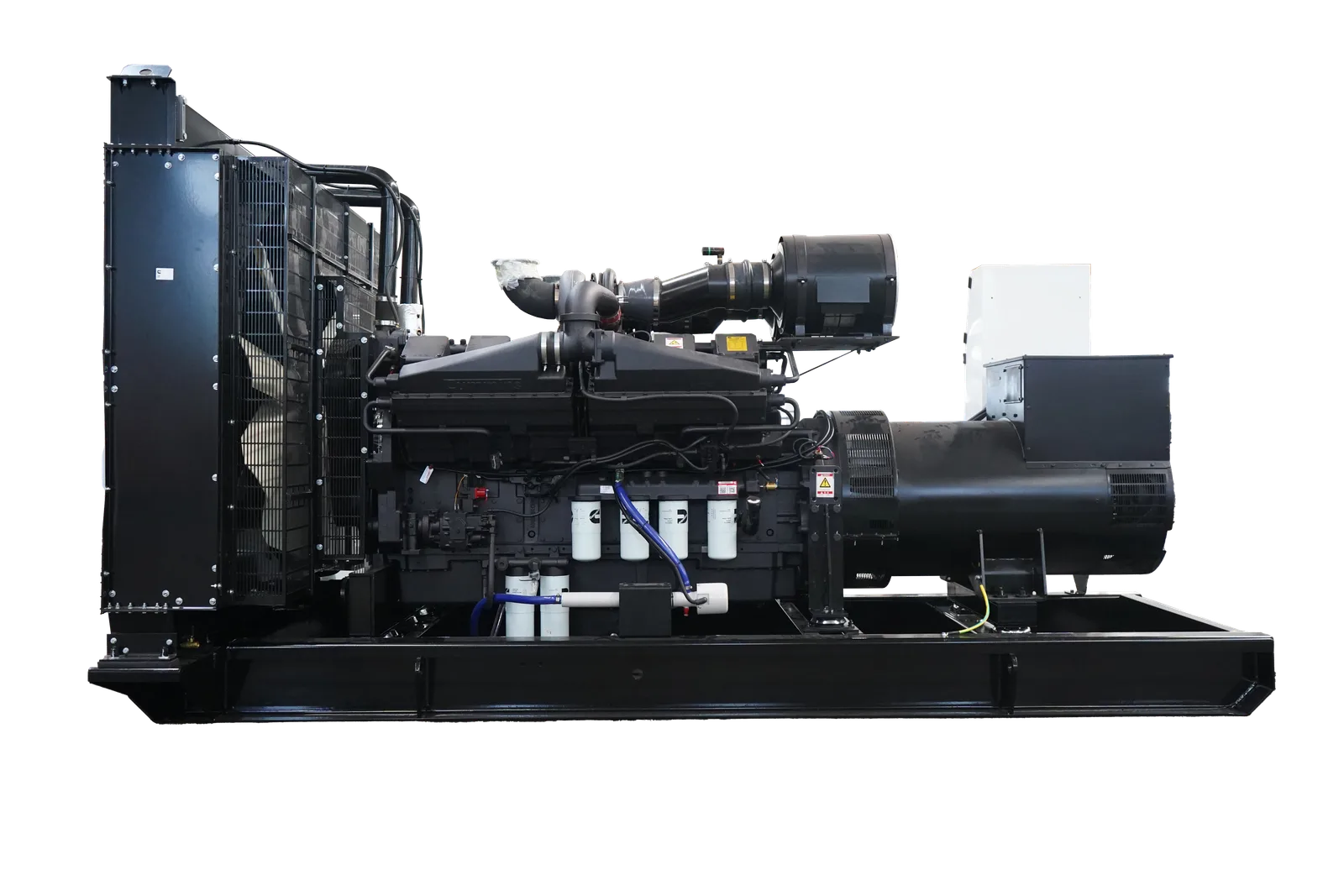
Verify make, model, serial number, prime/standby rating, speed, emissions and manufacturer data.
Confirm brand, winding, voltage, temperature rise, insulation, efficiency, excitation and recovery.
Check radiator, fan, hoses, expansion space and heat derating to verify continuous loaded output.
Verify batteries, starter, charging alternator, float charger and cold-start or long-standby conditions.
The controller should record electrical, engine, alarm and run-hour data and provide required communications.
Size output protection and terminal space around rated current, fault duty, selectivity and cable direction.
Check steel thickness, welding, vibration isolation, lifting, tank capacity, drainage and leak control.
Open and enclosed sets should allow safe service of filters, belts, batteries, controls and major components.
Six Project Inputs
Provide equipment list, largest motor, UPS or VFD loads, critical classes and loads that may be delayed.
Describe utility conditions, annual hours, average load factor, continuous duration and future growth.
Confirm country standard, kW/kVA, power factor, ATS, distribution and existing bus interface.
Provide temperature, altitude, dust, humidity, airflow, exhaust, access, lifting route and foundation conditions.
Define ATS, parallel-ready needs, feeders, autonomy, remote monitoring and loaded-test requirements.
Share specified makes, budget, local service resources, parts lead time and warranty-response expectations.
Typical Customer Tasks
Focus on batteries, ATS/UPS transfer, load priorities, fuel autonomy, periodic drills and traceable maintenance.
Fire, security, lifts, parking, payment networks, cold chain and tenant loads need priorities while outdoor systems control noise and visual impact.
Review production recovery, cooling, harmonics, parallel-ready interfaces, fuel delivery, monitoring and local service.
Share country and city, critical loads, largest starting equipment, estimated rating, standby or prime duty, 50Hz or 60Hz, voltage, environment, autonomy and brand preferences. HOHANK engineers will define rating, enclosure, engine-alternator combination and system modules.