Crusher station generator setup

Crusher station generator setup

For crushers, mills, feeders, conveyors and pumps with high starting current, review genset capacity, start sequence, paralleling and low-voltage distribution.

Crusher station generator setup

Crusher starting surge and voltage drop

Crushers, screens, feeders, and conveyors create high starting current. If the generator set is selected only by running power, the site can fail in real operation.

Scene background

After expansion, new equipment often exposes starting-current limits first

When a mine wants to increase shift production or add a new crushing and screening line, it usually first purchases a crusher, screener, feeder, conveyor belt, water pump or air compressor. The operating power on the equipment nameplate seems controllable, but the impact on the power system is greater at the moment of startup.

If the existing generator sets, low-voltage cabinets, and cables on site were configured only for the old load, new equipment may cause a clear voltage drop as soon as it starts, trip protection, and even affect other motors on the same line.
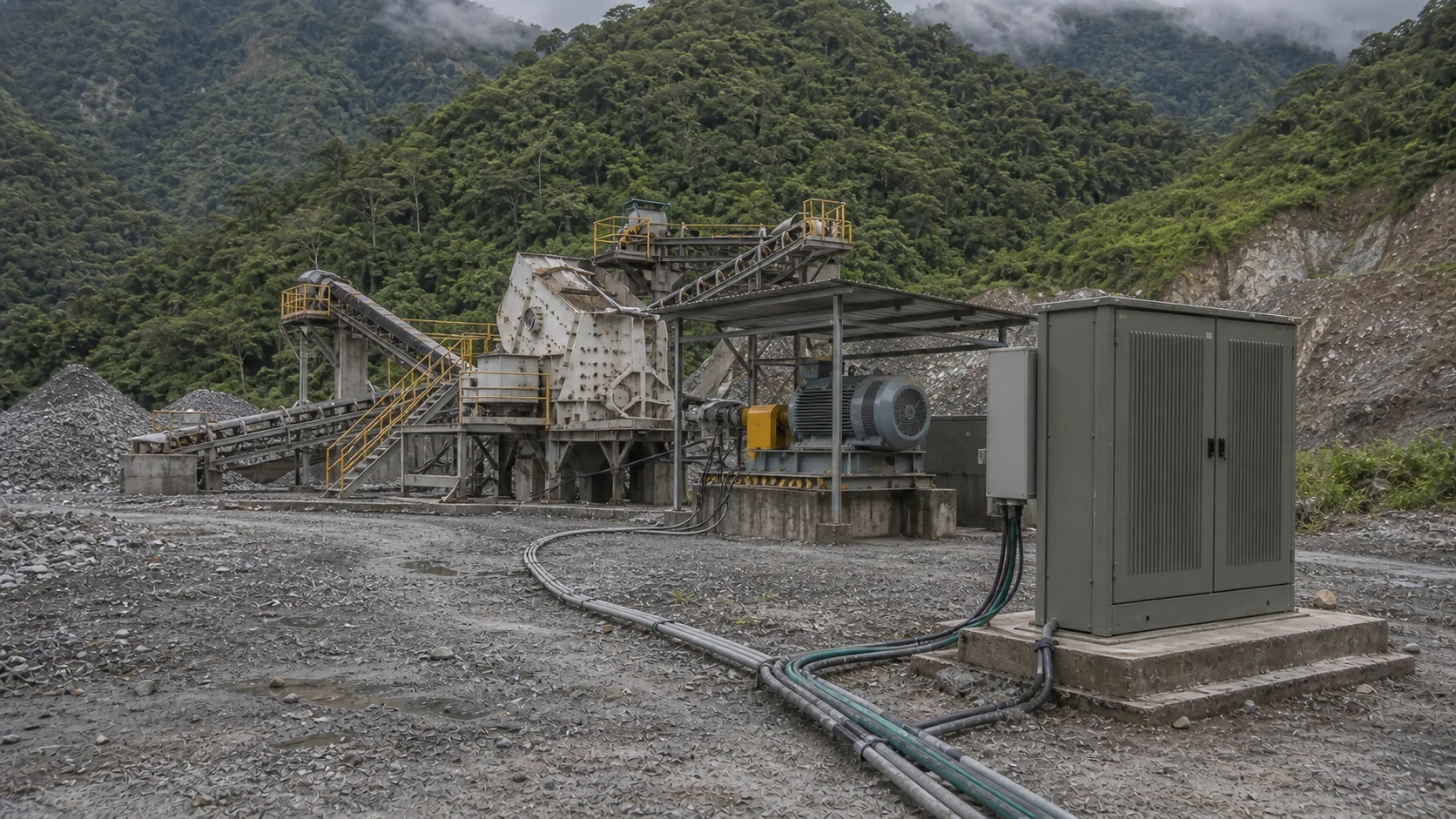

Site problem

The generator set looks large enough, but in real startup it cannot carry the whole line.

The most difficult thing for the person in charge of expansion to accept is that the equipment has been installed and a single piece of equipment can be started, but once it enters the linkage startup, it becomes unstable. The crusher trips when it starts, the conveyor belt and feeder interact with each other, and the voltage is pulled down as soon as the pump or mill is turned on.

Onsite personnel could only repeatedly adjust the startup sequence, temporarily stop some loads, or have electricians guard the control cabinet. The production line is not completely without power, but cannot start stably and run continuously as planned.

Crushing station diesel generator configuration On-site issue scenario

Operational consequences if left unresolved

If the power system cannot carry the load, expansion becomes trial and error

If the startup shock is not dealt with, the expanded production capacity will be stuck in the power system. Crushing, screening, conveying and pumping stations cannot be stably linked, shift output cannot increase, and equipment installation and commissioning time will also be lengthened.

The harder problem is misdiagnosis. The site may blame the equipment, control cabinet, or operation, while the real cause is often a mismatch between generation margin, paralleling control, low-voltage distribution, and startup sequence.

Recommended configuration

Recalculate capacity from motor starting method and startup sequence

First split the motor list into three categories: continuous operating load, starting impact load, and auxiliary load that allows delayed start. Crusher, screener, feeder, conveyor belt, pump and air compressor should record the starting mode, rated power, voltage frequency, interlocking relationship and actual starting sequence.

When selecting a set, focus on startup voltage drop and protection coordination: whether the capacity of a single generator set has enough margin, whether parallel operation should share the load, whether the low-voltage cabinet and cables can handle the impact, and which loads must be staggered. This lets the crushing line start according to the commissioned sequence instead of relying on repeated on-site trials.

Configuration confirmation steps

Review loads and confirm paralleling, distribution and protection logic

Build the load table from the equipment list, marking direct-start, soft-start, and VFD-start equipment, plus conveying, feeding, and dust-removal loads that must run together with the crusher.

Model voltage drop against the actual startup sequence. If needed, start large motors in groups or use paralleling control to share the inrush across multiple gensets, while checking spare capacity in the LV cabinet, breakers, and cables.

Put the startup sequence into the commissioning checklist: which equipment starts first, the interval between starts, which alarms call for voltage and frequency checks, and when the line must be stopped and reset. A new shift can follow the same startup logic.

Expected operational benefit

Expanding production is not just about buying equipment, but about stabilizing the start-up of the entire production line.

After completing the review, crushing, screening, conveying, pumping stations and auxiliary equipment have clear start-up queues, voltage fluctuations are suppressed within the acceptable range on site, and the unit will not repeatedly alarm or trip at the most difficult start-up moment.

When adding feeders, conveyor belts or pumping stations later, it can also be seen on site whether the bottleneck is capacity, parallel control, low-voltage cabinets or startup sequence. There is no need to rely on trial runs to find problems every time the production is expanded.

Information to confirm before quotation

Common site signals

  • The crusher trips when it starts
  • Conveyor belt or feeder motors interact with each other
  • The voltage drops significantly when multiple motors are started.
  • The generator set can start, but it cannot keep the whole crushing line running stably.

If this is not planned early

  • The expansion equipment has arrived, but it cannot operate in conjunction due to startup shock.
  • The startup sequence was repeatedly adjusted on site, which lengthened the commissioning time.
  • Voltage drops and trips will affect the rhythm of the entire crushing and screening line
  • It is easy to mistake it for an equipment fault or operating issue, while the real root cause remains in the power system.
  • When equipment is expanded later, the generator set, distribution, and protection logic must be reworked again

Project confirmation points

  • List of crushers, screens, feeders, conveyor belts, pumps and air compressor motors
  • Starting methods such as direct start, soft start or variable frequency start
  • Which loads must run at the same time and which loads can be started later
  • Existing generator-set capacity, paralleling conditions, low-voltage cabinet, circuit breaker, and cable status
  • Target shift output and subsequent new equipment plans after expansion

Recommended equipment scope

  • Collect motor list and starting method
  • Plan startup sequence and load priority
  • Reserve power generation capacity margin for motor startup
  • Adopt parallel control or staged operation
  • Review low-voltage distribution and protection logic

Engineer assistance

Contact an engineer first, then review the equipment and service scope together

Can the crushing, screening, conveying and pumping stations be put in stably according to the real start-up sequence, instead of just looking at the total power?

Equipment and module scope

Engineers check the diesel generator set, paralleling control, low-voltage distribution cabinet, breakers, and cable configuration against the starting method and protection logic.

Information engineers will help organize

  • Crusher, screen, conveyor belt and pump station power
  • Direct start, soft start or variable frequency start method
  • Startup sequence, interlocking relationship and simultaneous running loads
  • Photos of control cabinets, distribution cabinets and motor nameplates

Related equipment and service

1000-2000kW diesel generator setGenerator paralleling controlLow voltage distribution cabinetStartup sequence reviewDebug handover checklist

Engineer contact

Contact an engineer to review the right configuration.

If the information is incomplete, contact an engineer first. Start with the mine location, the site problem or the general equipment condition; the engineer will organize the loads, site conditions and configuration scope with you.

Scan WhatsApp to contact an engineer

An engineer will contact you soon to review your site issue and needs.

Scan WhatsApp to contact an engineer WhatsApp: +86 176 8575 2779
Email an engineerfeyqiao@hohank.com
or leave your contact information

An engineer will contact you soon to review your site issue and needs.

High-voltage mine buses and long-distance distribution

For 6.3kV or 10.5kV buses, long cable runs or large unit capacities, a high-voltage generator system reduces current and line losses while integrating switchgear, grounding and paralleling.

Get high-voltage engineering support
Email engineer